
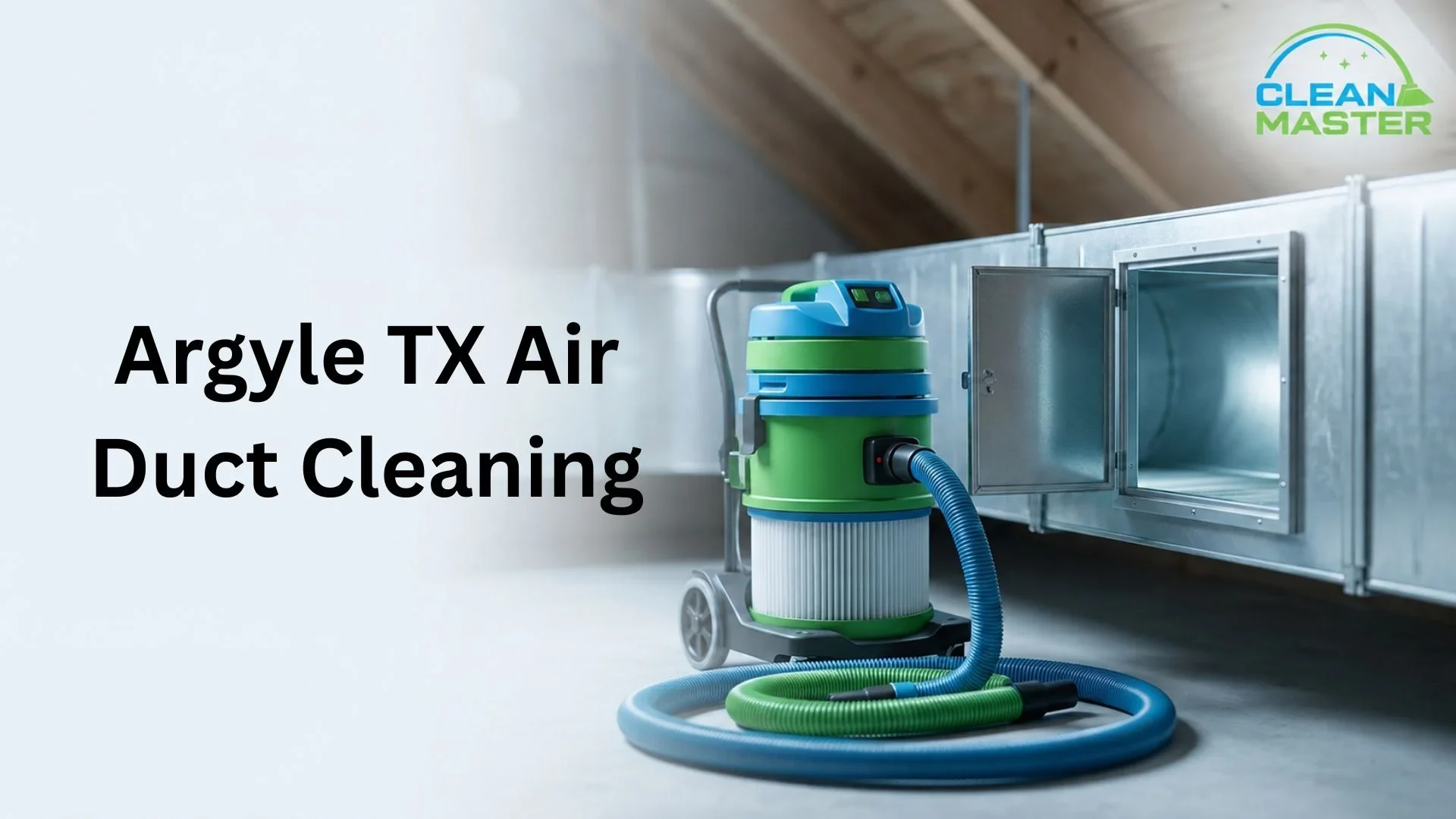
Argyle is a town of contrasts. Large estate homes on acreage sit not far from newer planned-community construction, and both types of properties tend to have more square footage and more ductwork than the average DFW home. That combination, bigger systems, longer duct runs, and in many cases genuinely open land around the house, creates duct problems that build up quietly and go unnoticed longer than they would in a smaller, denser neighborhood.
At Clean Master Carpet Cleaning, we’ve spent over 26 years cleaning air ducts in Argyle and across the greater DFW metro. We’re NADCA and IICRC certified. Here’s what we consistently find across Argyle’s mix of large estate properties and newer development.
Large Estate Homes: More Duct, More Places to Hide a Problem
Estate homes on acreage often run multiple HVAC systems, each with its own supply trunk, return, blower, coil, and set of branch runs reaching rooms far from the equipment. Longer duct runs mean air slows down more before it reaches the far end of the house, and slower air drops more of what it’s carrying along the way. In a multi-system home, there’s also almost always a unit that gets less daily attention, serving a wing, a guest space, or a room used only occasionally, and problems in that system go unnoticed the longest.
New Planned-Community Construction: Debris Before Move-In
Newer homes going up in Argyle’s planned developments follow the same pattern we see anywhere construction is happening. Ductwork gets installed early, then sits exposed for weeks or months while drywall goes up, gets sanded, and gets sanded again, often with the HVAC system running during finish-out. That pulls drywall dust, sawdust, and insulation fibers directly into the duct runs before a family ever sees the finished house. Builders almost never clean the ducts before handoff.
Acreage and Open Land: A Steady Source All Its Own
A meaningful number of Argyle properties sit on genuine acreage, and homes on open land pull in fine dust and grit through return vents at a higher rate than homes in denser, paved neighborhoods. That intake is fairly constant across the year, wind, dry stretches, and a DFW pollen calendar that runs mountain cedar through winter and ragweed through fall all contribute. There’s rarely a real off-season for it.
What Argyle Homeowners Usually Notice First
- One room or wing that’s always dusty, while the rest of the house seems fine
- Dust that resettles on furniture faster than seems normal
- Weak airflow from vents at the far end of a run
- Energy bills that don’t match the size or age of the system
- Allergy or sinus symptoms that seem tied to being home
- A filter that’s visibly gray or clogged well before the next scheduled change
DIY vs. Professional Duct Cleaning: A Side-by-Side Comparison
| Factor | DIY Cleaning | Professional Cleaning |
| Cost | Low, vacuum attachments, filters, tools you may already own | Custom quote based on system count, size, and condition |
| Time | 2 to 4 hours for vent covers and registers | Typically 2 to 4 hours on-site per system, with full-system access |
| Equipment | Household vacuum, brushes, disposable filters | Negative air pressure systems, rotary brushes, HEPA-filtered vacuums, video inspection cameras |
| Depth of cleaning | Reaches vent covers and a short distance into the duct | Cleans the entire system, supply and return runs, plenum, coils, and blower components |
| Multi-system estate homes | Each system needs separate attention, most people do one and stop | Every system inspected and cleaned as its own job |
| Best for acreage/rural homes | Routine upkeep between deeper cleanings | Sustained dust and grit intake from open land |
| Best for new construction | Not recommended right after move-in | Construction debris, drywall dust, insulation fibers left from the build |
| Risk | Can push dust deeper into ducts or tear flex duct if done incorrectly | Low risk when performed by certified technicians |
| Result | Surface-level improvement, often needs repeating | Measurable improvement in airflow and indoor air quality system-wide |
The short version: whichever situation describes your Argyle home, what you can reach by hand is a small fraction of what’s actually in the system.
When DIY Duct Cleaning Is Safe in Argyle
You can likely handle this yourself if all of these are true:
- Airflow feels consistent from room to room and zone to zone
- You’re only cleaning visible vent covers and registers, not reaching into the ductwork
- There’s no visible mold, no musty odor, and no history of water intrusion
- You haven’t had recent construction, renovation, or duct work done
- No one in the household has new or worsening allergy or respiratory symptoms
- You’re comfortable accessing vents without disturbing insulation or damaging flex duct
How to do it well: turn the system off at the thermostat and the breaker before you start. Unscrew the vent covers and return grilles and wash them in the sink with dish soap, that’s where most visible dust lives. Vacuum as far into the opening as the hose comfortably reaches using a soft brush attachment. Never force anything rigid into flex duct, the inner liner tears easily, and a torn liner is a much bigger problem than dust.
If you’re on acreage, check your filter more often than the standard schedule since open land pulls in more particulate than a paved neighborhood does. Change every filter, not just the easy one if you have a multi-system home, since the forgotten unit is usually the dirtiest.
That’s genuine maintenance for a home with no specific problems. We’d rather tell you that than sell you something you don’t need.
When to Call a Professional
It’s time to bring in a certified technician if any one of these applies:
- You’re on an acreage or estate property and haven’t had the ducts checked in years
- You’ve moved into a new construction home in Argyle, builders rarely clean ducts before handoff
- One room or zone is always dusty while the rest of the house is fine
- You see dust blowing visibly out of vents when the system kicks on
- You’ve finished a renovation involving drywall, demo, sanding, or flooring
- There’s visible mold, a musty smell, or you’ve had recent water intrusion
- There’s evidence of rodents, insects, or nesting material in the system, common on acreage properties
- Household members have unexplained allergy flare-ups, coughing, or sinus issues
- Your energy bills have crept up without an obvious cause
- You’ve got multiple systems and only ever think about one of them
Real Case Study: Open-Land Dust in an Argyle Estate Home
The situation: A homeowner on an Argyle acreage property reached out about persistent dust throughout the house, heavier and more constant than they’d dealt with in a previous, more suburban home. They’d already stepped up their regular cleaning routine and swapped filters more often, but the dust kept coming back at a pace that didn’t match the effort they were putting in.
What we found: The home’s return system was drawing in a steady volume of fine dust and grit consistent with open-land exposure, the kind of fine particulate that comes through gaps and connections faster than a typical filter schedule can keep up with in a paved, denser neighborhood. Inside the duct runs themselves, we found real accumulation built up over time, along with a filter that was already gray well before its scheduled change.
What we did: We performed a full inspection and complete cleaning of the system using negative air pressure equipment, covering the supply and return runs, the plenum, and the blower components. We also walked the homeowner through a shortened filter replacement schedule specific to an acreage property, a meaningfully tighter interval than what’s typical in town.
The result: The homeowner reported the household dust dropped off noticeably, and the difference between cleanings became much less pronounced.
The honest part: Open-land dust isn’t something a single cleaning permanently solves, it’s an ongoing condition of the property, not a one-time event. What changes is the maintenance rhythm. Homes on acreage in Argyle generally need shorter filter intervals and more frequent duct attention than a comparable home in a paved subdivision, and that’s worth planning for rather than being surprised by.
Frequently Asked Questions
Does living on acreage in Argyle affect my air ducts?
Yes, significantly. Homes on open land pull in more fine dust and grit through return vents than homes in denser, paved neighborhoods. That intake is fairly constant across the year, which means these systems typically need shorter filter intervals and more frequent duct attention than a comparable home in town.
Do large estate homes in Argyle need duct cleaning more often?
Not necessarily more often, but more thoroughly. A large estate home has more duct, longer runs, and often multiple HVAC systems, each with its own filter and blower. That means more places for debris to settle and more zones where a problem can go unnoticed, especially in a system serving a rarely-used wing.
Do new construction homes in Argyle really need duct cleaning?
Yes, more often than not. Ductwork is installed early in the building process and stays exposed while drywall, flooring, and trim work continue around it. Builders almost never clean ducts before handoff, so construction dust is routinely present before a homeowner ever moves in.
How often should air ducts be cleaned in the Argyle area?
For most homes, every 3 to 5 years is a reasonable baseline. Move that up if you’re on acreage, in new construction, or you’ve noticed uneven airflow between zones in a multi-system home.
Will duct cleaning lower my energy bill?
It can. Dust and debris buildup restricts airflow, which forces your HVAC system to work harder to reach the same temperature. In a home with multiple systems and long runs, that inefficiency multiplies. Clearing the buildup often improves efficiency, though results vary by home and system condition.
What certifications should I look for in a duct cleaning company?
Look for NADCA and IICRC certification at minimum. It’s also fair to ask whether they use negative air pressure equipment, whether they’ll inspect every system in a multi-system home, and whether they’ll show you before-and-after photos of your own ductwork.
Ready for a Duct Inspection in Argyle?
Whether you’re on acreage dealing with steady open-land dust, in a new build with leftover construction debris, or managing a multi-system estate home, Clean Master Carpet Cleaning has spent over 26 years serving Argyle and the greater DFW metro. We’re NADCA and IICRC certified, and we know how to tell which situation applies to your property. Contact us today for a free quote and inspection, we’ll check every system on the property and tell you honestly whether your ducts need cleaning or whether you’re fine for now.